


 I have had my iPhone for few months now. And I've been playing with all these wonderful and useful apps ever since. But not until recently, it dawned on me that there should be one for drawing. It's like remembering there's such a thing called pen upon seeing papers. Couldn't be more obvious.
If we human came so long to click, drag and type on a piece of glass, how more primitive and imperative to just scribble with our index finger, albeit it's not steamed.
A search word "paint" brought me a dozen such kind of apps in the iTune store. I found MyPaint Free so far the best among the free ones. Simple and quick. So now my iPhone is also an "iPad". Sketch on the go. Few samples above.
2.6.09
Sketches on iPhone


5.5.09
Giorgio Morandi and now George Shaw
Sometimes one comes to a point of life, you look back and regret.
You don't want to admit it but you have to be brave and be honest to yourself. I know some suggest that we should not regret because we cannot change the past, but the present. I find this argument lame. To regret doesn't necessarily mean we have to live in the shadow of the past. It's precisely the knowledge of the past that teaches us how to live our present. Besides, the most noble thing a human being possess is the ability to regret – the confirmation of the existence of our free will. We can choose, therefore there is always the possibility of another path, for better or worse. Then you can say to yourself: okay, I've been a jerk, should I continue to be a dumber jerk, or CHANGE to be a smarter one? There due comes the possibility of a fresh start, to be the person you always want to be, to do the things you always want to do, or should have done.
This is the profound thought I'm having at the moment.
 |
| Crossing, 1996, 30" x 39", Oil on canvas |
 |
| On Way Home, 1996, 30" x 38", Oil on canvas |
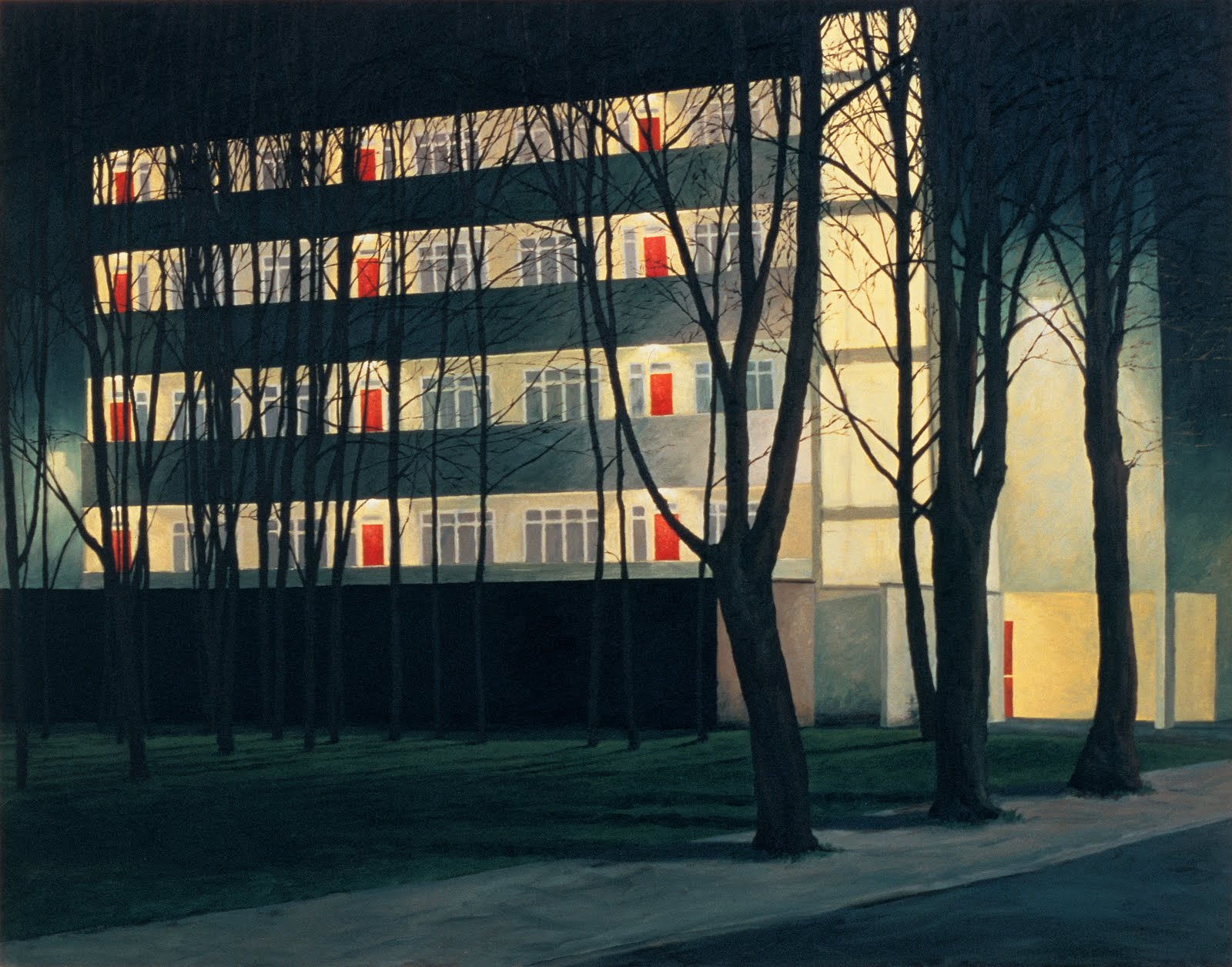 |
| Pass Over, 1996, 30" x 38", Oil on canvas |
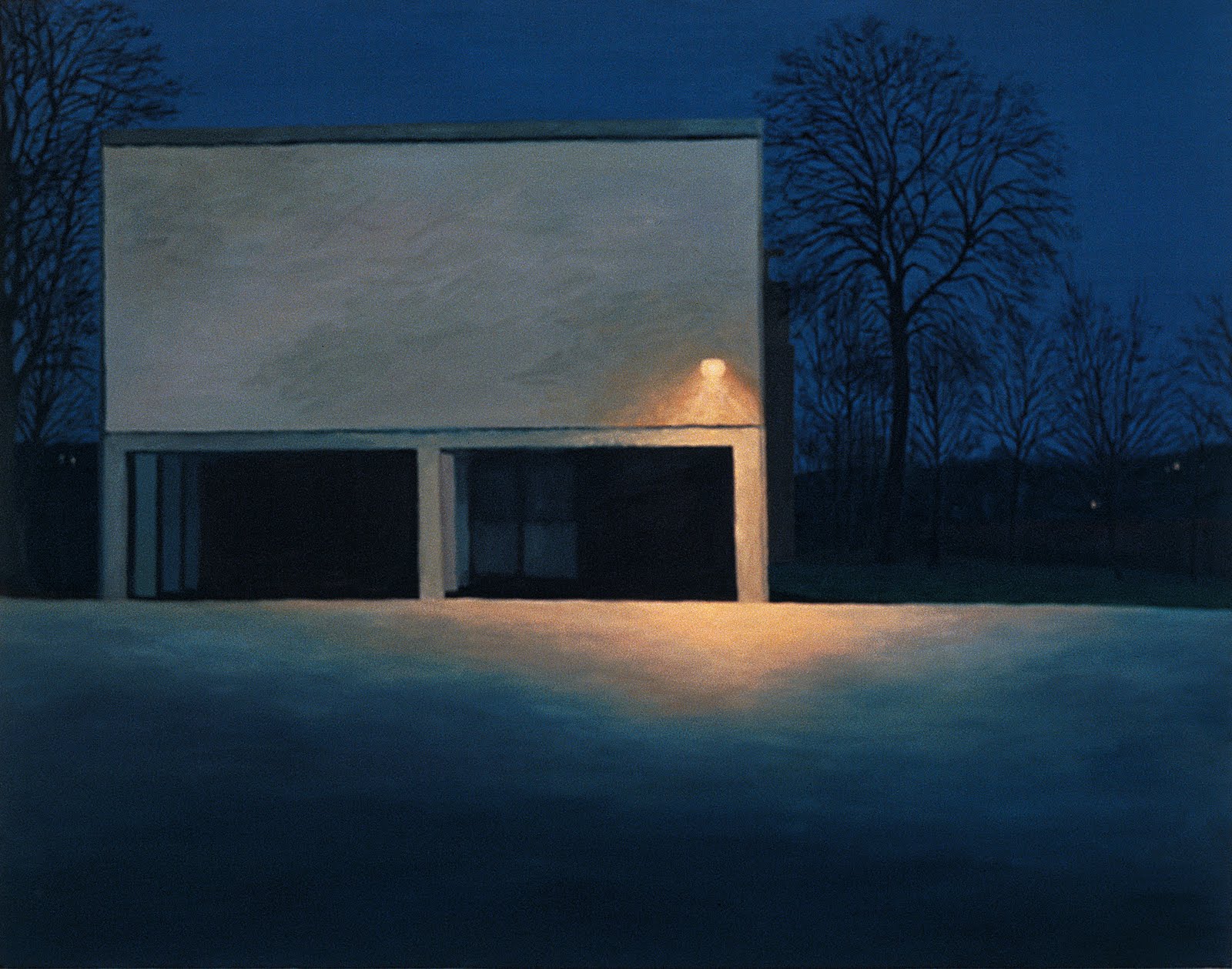 |
| The First, 1996, 30" x 38", Oil on canvas |
My best mate Steve, a student from Newcastle, said to me when I couldn't get a work-permit and had to go back to Hong Kong, "You are a fxxking good painter, you know man? Don't ever never stop painting!" His funny Geordie accent still rings in my ears.
But I stopped. I decided the only natural survival path is to get a design related job and make a living. And the rest is history. (Don't get me wrong. I love my job. Just a pity I didn't paint all along.)
Eventually the small voice inside me got his reward. About a year ago, I picked up my paintbrush again. But it's all a bit of stop-start. During the weekends, it's impossible not to find more "interesting", easier things to do than waiting for the "right mood", sorting out the subject matters, setting up the easel... oh just a minute, the Premier League matches is on the telly.
 |
| Geroge Shaw, Ash Wednesday: 8.30am (2004-5). Humbrol enamel on board |
 |
| Geroge Shaw, Scenes from the Passion: Late 2002. Humbrol enamel on board |
The more I read into it, the more I found our similarities. He felt the same disillusion when graduated from Sheffield Polytechnic before started to paint again in his MA at Royal College of Art in London, and would you believe it, in the year of 1996! I certainly share his sentiment in depicting unpopulated scenes of Tile Hill where he grew up, though the motive is different. His is one of remembering, the lost passions of youth. Mine was the visualization of a presence, between the physical and little beyond.
Without any warning, all the loveliness, passion and meanings of what it takes to paint rushed back to me. What was barren, now flooded. I was immersing myself in these nostalgia of empty streets of Camberwell, lights in the dark of Elephant and Castle, typical yellow brick houses of England, and most of all, the very act of putting paints on a canvas. It's poignantly sweet.
Of course, feeling comes and goes. A little healthy self-indulgence here has no value to me if it doesn't turn to some concrete actions.
Every good painter knows when to stop and call the work finished. Excuse me for this overdone self-retrospective. I'll end here by saying:
Let's not be afraid to admit our past stupidities, just make sure we regret lesser as we get older. When we are driving ahead, it would be foolish and even fatal not to look at the rear-view mirror, wouldn't it?
And my canvases are calling.
18.4.09
"...I felt happy, almost indestructible in a way."

It was one of those great spring days, it was Sunday, and you knew summer would be coming soon. And I remember that morning Dorrie and I had gone for a walk in the park and come back to the apartment. We were just sort of sitting around and I put on a record of Louie Armstrong, which was music I grew up with, and it was very, very pretty, and I happened to glance over and I saw Dorrie sitting there. And I remember thinking to myself how terrific she was and how much I loved her. And I don't know, I guess it was a combination of everything just seemed to come together perfectly and I felt happy, almost indestructible in a way.
Sandy Bates in "Stardust Memories", written by Woody Allen
I read this the other day and it was painting this picture of Edward Hopper in my head. Not sure why. Maybe the sound from afar to which the dog is turning his head, is that same music of Louie Armstrong?
It's not the parties,
the New Year's Eves
or even the day you married,
but in a day like any other day,
out of the blue,
(more than coincidence,
with someone you love)
you feel happy,
unadulteratedly.
7.4.09
The Cat with Three Legs

 Mimi belongs to the vet my cat seeing. She's a perfectly healthy cat, except her left hind leg were amputated.
Energetic and often vocal, she's more like a housekeeper in the vet, patrolling up and down, and meowing in a low tone to express her discontent of over-crowded dogs (or simply just to get attention).
Every time I see her, I feel lifted. I say to myself: if she can survive with three legs, I can survive with two, no matter what.
Remark: I got a lot of traffics coming from search words "cat with three legs". Some as specific as "Can a cat with three legs survive?" So, here's a bit more info about Mimi that may help:
Mimi was nine when she's badly injured and was brought to the vet. But her loveless owner didn't want to keep her because of the prolong medical expenses . So the vet decided to keep her their own. Eventually she got well and has no problem whatsoever in daily life. Now she is nineteen years old.
4.4.09
1.4.09
The Physical Impossibility of Death in the Mind of Someone Living to The Metaphysical Possibility of Afterlife in the Mind of Someone Dying

On a casual day, not outrageously busy in the office, I popped into a blog and read this:
"In a hundred years I'll be dead. So will you. Before that time comes, I want to keep asking the question, "How do we make the world a more fun, meaningful, loving, creative place?"
– Hugh Macleod, gapingvoid.com, Post March 10, 2009
The first fourteen words have been lingering on my mind since.
Then the phone rang, I had a funeral to go.
Amid the noise, chanting and occasional deafening gong as the priest of Tao performing their rituals, the title of the iconic shark by Damien Hirst came to me: "The Physical Impossibility of Death in the Mind of Someone Living".
Most of us, most of the time, see Death like this: a distant relative who will come visiting me one day. But definitely not today. Not remotely tomorrow. With average luck, neither the day after. In the mean time, I won't of course bother to call him asking "how are you?", least about how I should live my daily life. That's about it.
What will be my reaction when I finally see him face to face? Terribly frighten? Maybe. Proud and having no regret? I hope so.
The answer may well depend on what I fill in the blanks after that fourteen words.
No revolution planned. Nothing extraordinary happened. But this brief thought of death did make me feel inspired. A sting in my butt. A kick to seize my remaining days, before the inevitable meeting with our common relative who annoyingly sent me this junk mail attached with a shark.
Few weeks passed, now my line of thought is this: In a hundred years I'll be dead. So will you. After that?
2.3.09
Now Google Earth extends to its Garden of Delight, Hell and more.


These freaky images are snaps I took while visiting Eden and Hell beside (not "besides") the Garden of Earthly Delights. I'm referring to the painting by Bosch, which is a triptych depicting the central theme with Eden on the left panel and Hell on the right. Thanks to Google Earth's mapping technology. The Prado Museum of Madrid became the first to open its collection online, allowing anyone to take a virtual view of their 14 masterpieces in ultra super mega high resolution. You can zoom in closer and closer, until it’s like putting your nose right up to the canvas (without security guards shouting at you). The aged paint and cracks become almost physical on your screen.
Other famous paintings include, Velázquez's Las Meninas, Goya's The 3rd of May 1808, Rembrandt's Artemis, Rubens’ Three Graces, Raphael's The Cardinal and more. I suspect other museums will soon follow. Wouldn't it be wonderful when one day all the art pieces in the world can be viewed at our fingertips? Then we could be freely greeted by the famous Smile or the terrible Scream.


 You can click this link to see the reduced version by Google Map. But I highly recommend you to install Google Earth. Then you can truly appreciate the beauty of technology and the masterpieces it brings to you, right up to your nose.
23.2.09
"I chose love."
Just a minute ago, I watched the Oscar winner of Best Score and Best Song for Slumdog Millionaire, A.R. Rahman saying this:
"...The essence of the film which is about optimism and the power of hope in the lives, and all my life I had a choice of hate and love. I chose love and I'm here. God bless."
10.2.09
A new phone called Pomegranate

Normally I don't talk much about latest innovative gadget. But today I've got a link introducing a phone industry breakthrough which appears to be one on par, if not above, iPhone for the time being. It's called the Pomegranate NS08. A phone claimed to be able to do all the usual mobile phone stuffs plus whole new added abilities like: gps system, movie projector, global voice translator, razor, harmonica and even brewing coffee!
Too good to be true? I leave you to find out.
www.pomegranatephone.com
2.2.09
Andrew Wyeth died

One of the best-known American realist painter, died on 16th last month, aged 91.
Almost all his paintings were about people and places around him in his hometown of Chadds Ford, Pennsylvania and his summer home in Cushing, Maine. The above is probably his best-known painting, Christina's World, depicting his neigbour who was crippled by polio crawling back to her house, now known as the Olson House.
He painted with tempera, an egg yolk based paint medium widely used before oils. I tried myself in school days (out of curiosity that egg goes well with pigments besides bacon). It proved too difficult for me to grasp. It's similar to acrylic, only dries extremely fast that leaves no room for you to mix on panel. So it's a painstaking process of layering and layering. Patience were short then. Weyth finished about two paintings in a year. You can see why.
One interesting fact worth mentioning. M. Night Shyamalan based his movie The Village on Wyeth's paintings. The village seen in the film was built in its entirety in one field outside Chadds Ford, not far from Wyeth's studio. Can you tell from below their connection?

He is the painter who was loved by the people more than critics. A typical situation reflects what often happens between the "art world" and the general public. An extract from The Wall Street Journal by columnist Terry Teachout may sum up the point:
Part of Wyeth's problem, of course, is that he was so very, very popular. In the ever-relevant words of Max Harrison, "People do not object to artists deserving success – only to their getting it." At a time when the vast majority of serious American art critics believed abstraction to be the One Best Way to paint, it was hugely irksome that America's most successful painter should have been firmly committed not just to representation, but to near-photographic realism. Why did the benighted masses insist on preferring "Christina's World" to the drips and spatters of Jackson Pollock? The answer was self-evident, at least to the art-world commentariat: Most people are stupid.
Though the debate between styles of art seems pointless these days of the postmodern, our appreciation of arts will always be influenced by the critics, media and the overall temperament of our time. The best we can do, I suggest, is to put on a noise-cancelling earphone, stand in front of a painting and listen only to our eyes.
Subscribe to:
Posts (Atom)

 Posts
Posts


